Free dMAT Mock Test 2026: full-length practice, no signup
AdmitVerse offers free dMAT mock tests built on the official g.a.s.t. exam format — no payment and no card. The 20-item Figure Sequences mock runs in your browser on this page with no signup at all.
Three timed Core Module subtests (Figure Sequences, Mathematical Equations and Latin Squares) plus the General Academic Module, with instant scoring and a worked solution for every question. Don’t walk into a ₹16,500 exam blind.
AdmitVerse is an independent preparation provider. We are not affiliated with g.a.s.t. or APS India, and these mocks are not official dMAT papers. Registration for the real exam happens only at d-mat.de — and your APS documentation at aps-india.de. Exam facts last checked 15 September 2026.
Free dMAT Figure Sequences mock: 20 items, 25 minutes
A timed Figure Sequences set on the g.a.s.t. format, 20 items in 25 minutes. That is the same 75 seconds an item the real subtest allows. It runs here in your browser. There is no signup, no payment and no card: press start and you are in the test, with your score and a worked solution for every item the moment you finish.
- Items
- 20
- Time
- 25 min
- Per item
- 75 sec
The clock starts when you press it. Nothing is saved unless you ask.
Register on the official g.a.s.t. portal before 15 Sept 2026
Do I even need the dMAT?
Most applicants aren’t sure whether this exam applies to them. Answer 4 quick questions for an instant verdict.
What are you applying for in Germany?
The dMAT only applies to Master’s applicants.
Self-check — not an official g.a.s.t. / APS determination
Prepare for an exam with
no past papers
Backed by AdmitVerse, the study-abroad platform used by applicants heading to Germany.
Students counselled
Destinations
On Google (36 reviews)
TU Munich
Munich
RWTH Aachen
Aachen
LMU Munich
Munich
Heidelberg
Heidelberg
TU Berlin
Berlin
Stuttgart
Stuttgart
Mannheim
Mannheim
Göttingen
Göttingen
Your complete dMAT mock test library
Full-length and module-wise dMAT mocks, built on the official g.a.s.t. format, with AI analysis on every attempt. All six sets are free.
Frei (free) = full attempt, no signup or card required
Practise one Core subtest at a time
Worked questions, solutions and the method for each — free, no signup.
Not just tests — a complete AI mentor
Every feature is built to turn your attempts into a measurable jump in accuracy and pace.
AI Performance Analytics
Every attempt is decoded by our AI engine — accuracy, speed, decision quality and reasoning-type mastery — turning raw scores into a clear, personalised plan for what to fix next.
Sample readout · Mock 02
Weak Area Detection
Pinpoints the exact reasoning types dragging your score down.
Detailed Solutions
Concept-first written walkthroughs for every question.
Pace vs the exam clock
Your seconds per item against the 75 the dMAT allows.
Strategy Builder
AI-crafted attempt strategy for the 3.5-hour paper.
Difficulty Analysis
See how you fare across easy, medium and hard.
Time Management
Question-level time tracking and pacing insights.
Error Tracking
Silly mistakes vs reasoning gaps, separated clearly.
Adaptive Recommendations
Next-best practice served automatically.
Bookmark Questions
Save tricky questions to revisit anytime.
Progress Dashboard
Your entire prep journey in one view.
A test interface that feels effortless
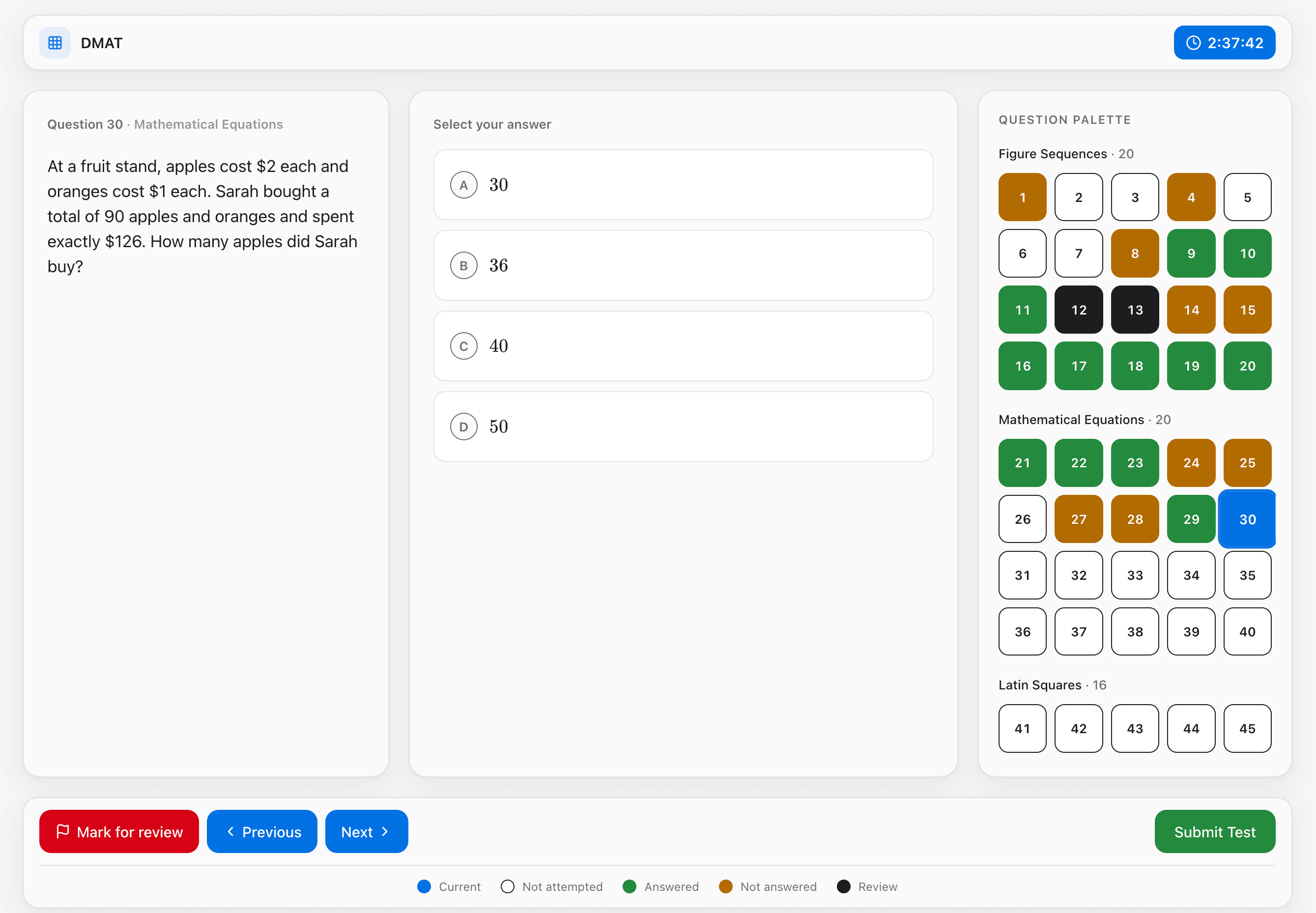
Question palette grouped by subtest, a running clock, mark-for-review and a status legend. No calculator, because the dMAT allows none.
See your performance like never before
Every attempt broken down by why you got it wrong — then turned into what to fix next.
On current form you land around 47–57.
- Dual-rule sequencesFigure Sequences
- System substitutionMathematical Equations
- Data interpretationGeneral Academic
- Correct275 · 38%
- Unattempted284 · 39%
- Conceptual142 · 20%
- Careless13 · 2%
- Guess10 · 1%
8% of your wrong answers were careless — pacing is the cheapest win.
| Section | ✓ | ✕ | — | Acc |
|---|---|---|---|---|
| Figure Sequences | 5 | 11 | 4 | 31.3% |
| Mathematical Equations | 1 | 5 | 14 | 16.7% |
| Latin Squares | 0 | 0 | 16 | 0.0% |
| General Academic | 0 | 0 | 20 | 0.0% |
Your result, screenshot-ready
Finish a mock and get an instant pace card — the kind you screenshot and drop into your group chat.
You averaged 91 seconds per item. The exam allows 75.
Challenge a friend
It’s not pass/fail — it’s you vs the clock. Send your pace and see who’s closest to exam speed.
One subscription, the complete arsenal
No add-ons, no surprises. Every tool you need to go from first attempt to exam-day pace.
dMAT sample questions — free PDF
30 practice questions with a full worked solution for every one — 10 Figure Sequences, 10 Mathematical Equations, 6 Latin Squares and 4 General Academic items, in the format g.a.s.t. publishes. Questions first, answers at the back, so it works as a paper you can actually sit.
No email, no signup — it is a direct download
What does this cost?
Nothing today. All six mock sets, every analysis breakdown and a counsellor are free during early access — no payment and no card. The 20-item Figure Sequences mock above needs no account at all.
What happens when early access endsWhat the dMAT actually looks like
No past papers, no toppers' notes — so here is the official format instead, straight from g.a.s.t.
90 min core, 30 min break, 90 min subject.
- Core Module, then a 30-minute break, then the Subject Module — three and a half hours in total.
- You may not take notes during the exam.
- Scored 0–200 per module with 100 as the average, plus a percentile rank against everyone who sat that date.
Figure Sequences
A figure shifts position, colour or orientation across a row of matrices by a fixed rule. You work out the rule and pick the matrix that comes next.
Mathematical Equations
Small systems of equations where letters stand for whole numbers, with exactly one solution. No calculator — this rewards fast substitution, not advanced algebra.
Latin Squares
A partly filled 5×5 grid where each letter A–E appears once per row and once per column. You deduce what belongs in the marked cell.
General Academic Module
A short academic scenario — often with a table, figure or passage — followed by single-choice questions. Every APS India applicant sits this module, not a field-specific one.
Read g.a.s.t. first. Then rehearse it.
What the official preparation material gives you, and the part it deliberately leaves to you.
| Official g.a.s.t. material | A timed AdmitVerse mock | |
|---|---|---|
| Question format | Documented, with examples of each subtest | The same formats, in volume — 20 Figure Sequences items in one sitting |
| The clock | Published: 25, 25 and 20 minutes for the three Core subtests | Runs against it, and tells you your seconds per item afterwards |
| Full-length rehearsal | Not provided | 210 minutes end to end — Core, the 30-minute break, then the module |
| Worked solutions | Answers for the sample items | The reasoning for every item, including why each wrong option is wrong |
| Where you lose marks | Not provided | Correct, incorrect and unanswered split by subtest |
| Past papers | None exist — the first sitting is 26 September 2026 | None either. Anyone selling dMAT past papers is not describing a real exam |
| Counts towards your APS | Yes — the dMAT certificate is issued by g.a.s.t. | No. Practice only, and not affiliated with g.a.s.t. or APS India |
g.a.s.t.’s own material is the reference and the first thing worth reading. AdmitVerse is not affiliated with g.a.s.t. or APS India, and only g.a.s.t. issues a dMAT certificate.
Questions? We've got answers
About these practice tests. Questions about the exam itself are answered on the dMAT guide.
Is the dMAT mock test really free?
Yes. AdmitVerse offers free dMAT mock tests built on the official g.a.s.t. exam format — no payment and no card. The 20-item Figure Sequences mock runs in your browser on this page with no signup at all, and every mock set is free during early access. Nothing on this page is behind a paywall.
Do I need to sign up to take a dMAT mock test?
Not for the 20-item Figure Sequences mock on this page. Press start and you are in the test; your score and a worked solution for every item appear the moment you finish. An account is only needed for the full-length 210-minute mocks, where attempts and analysis are saved between sessions. That account is free too.
Is there a free dMAT mock test online?
Yes — this one. It runs online in your browser with no download and no signup: 20 Figure Sequences items timed to the 25 minutes the real subtest allows. You get your score, your seconds per item against the exam’s 75, and the reasoning behind every answer, immediately and free.
How many free dMAT mock tests can I take?
Six sets, all free: three full-length 210-minute papers on the real Core-plus-General-Academic structure, and three timed Core sectionals — Figure Sequences (20 items, 25 minutes), Mathematical Equations (20 items, 25 minutes) and Latin Squares (16 items, 20 minutes). You can retake any of them as many times as you like.
Are there dMAT past papers or previous year question papers?
No, and nobody has them. The first dMAT was sat on 26 September 2026, so no previous-year paper exists and anyone selling one is not describing a real exam. What does exist is g.a.s.t.’s own preparation material documenting the format — which is what these mocks are built on.
How long is a full-length dMAT mock?
210 minutes, matching the exam: a 90-minute Core Module, a 30-minute break, then the 90-minute General Academic Module. The sectional mocks are 20–25 minutes each, which is what makes them usable on a weekday.
What does the mock interface look like?
One item at a time, a countdown for the section, and a numbered palette showing which items you have answered so you can jump back. No calculator and no notes, as in the real test. At the end you get your score, your seconds per item against the exam’s 75, and a worked solution for every item.
Why take mocks if it’s an aptitude test?
Because it’s timed, unfamiliar, and costs ₹16,500 per attempt. Mocks give you format familiarity, pacing practice, and a section-by-section read on where you lose marks — before the attempt that costs you.
Are AdmitVerse mocks official?
No. They’re built on the official g.a.s.t. structure and sample materials. Official content is determined solely by g.a.s.t., and AdmitVerse is not affiliated with g.a.s.t. or APS India.
Don’t walk into a ₹16,500 exam blind.
Twenty timed items, in your browser, right now. No signup, no payment, no card — and you know your pace against the exam clock in twenty-five minutes.